This is an article I wish someone had written for me a long time ago. Your reading this suggests that you either have a competition coming up or you’re considering it.
TLDR? Key take-aways
- The Reality Check: Understanding that Judo is a “sudden death” sport helps you accept risks and focus on the present.
- Define Your ‘Why’: Why are you competing? Use the event for stress inoculation and self-discovery, not just a medal.
- The Choke Factor: Learn why “over-thinking” leads to losing before you even step on the mat.
- The Mindset Trigger: How to use physical cues and calming music to flip the switch into performance mode.
Hopefully this summary will entice you to read the rest. Please read on…
Defining a competition
Covering the basics here: a Judo competition is an objective test of the standard of your Judo. The metric is the medal. Pure and simple – that’s it.
In our sport, a competition is a showing of how good you are on that particular day, against a list of semi-arbitrary list of competitors.
Let’s now start with the disclaimers:
- Judo is a sudden death sport so one minor, trivial blunder could have you lose the match.
- Fitness plays a role in this, you may have better Judo than the other guy/gal but that Big Mac diet and gym avoidance isn’t doing you any favours.
- You may be in the right weight category, but there can be a massive difference between top end and lower end when the gong for Golden Score strikes.
- Age is the great leveller – you may be the same weight, height and experience as the opponent, but if they’re 20 years your junior….. they’re able to recover quicker, exert themselves for longer, be more flexible, more… everything… Let’s face it!
- They may do more competitions than you. If they do, then they’ll be pushing the needle even more in their favour. I’ll come to that later.
Things you should be asking yourself
Well before the day of execution competition, try and answer these questions truthfully. If you don’t like any of the answers, you’ve got a bit of time.
- Are you physically ready?
- Are you doing this to get better? Hint: the right answer is ‘yes’.
- Are you inviting a lot of people for your matches? Inviting the family along may seem like a good idea but that’s if you like a bit of additional social pressure.
- Just how important is it to you?
Why are you doing this?
The “Why” is possibly the most important question to ask and has an impact on everything you do on Competition Day, including how well you do. If you’re reading this blog, you’re likely a recreational player that does this as a hobby. If that’s the case, you should be signing up in order to:
- Battle-test yourself and the game plan you’ve been practicing the past few months
- Harness the adrenalin dump which has applications in other areas of your life. Essentially stress inoculation.
- Develop that “mental prep” before you get on the mat
- Develop self expression and leading to your own beautiful Judo style
- Get better at competitions. The more competitions you do, the better you’ll perform at competitions.
- Learn more about what makes you tick. Essentially, self discovery. Lame as that sounds, but we spend our lives
Why you shouldn’t be doing this
Naturally this competition is important to you, otherwise you wouldn’t be doing it! But just remember, and this may frustrate you to hear, but noone cares in the medium to long term, and this day will be forgotten. Any sleepless nights you might have, any nerves, any anxiety you have, it’s going to be forgotten, everyone will move on. Why? Because we’re all by our very nature self-absorbed. This ‘thing’ that’s important to us is a personal and fleeting thing, whatever endeavour we undertake. Granted this may sound like a philosophy discussion but it’s worth reflecting on that.
That previous paragraph needs to be said. I reflect on some of my earlier competitions where I bigged the whole thing up in my head so very much that it created serious conflicts in my day-to-day.
Even if you’re well aware of the above points and you’re still feeling jittery about your upcoming competition, remember that you are programmed this way. How so? Your genetic programming is still stuck in the behavioural loop where for hundreds of thousands of years previously your ancestors had to make fight or take flight (otherwise there would be dire consequences) on a day-to-day basis. This programming always sits below the surface. Whilst the potential clashes with with sabre-toothed tigers or woolly mammoths may be unlikely, when things get stressful enough for us, our hormonal system floods our bloodstream with enormous amounts of adrenaline. To iterate: what you’re going through is normal. And further to what I said before, repeat exposure (provided you position the experience in your mind in the right way) is a method of inoculation.
The ‘How’ of going in for a competition
In a previous article I touched upon what you physically would need to bring. Let’s cover the mental side here and I’ll provide a personal story to this..
For a time I did well in competitions and mentally it was manageable. I’d feel ok leading up to the event – provided that I deliberately forced myself not to think about it.
Then one day a competition came along where I got to the venue too early. I didn’t have any team mates with me so I had no-one to chat to. Then I spent roughly two hours pacing back and forth with next to no distraction. I was trying to avoid thinking about the competition but my wayward brain wouldn’t have any of it. I progressed to running through the upcoming matches mentally over and over, consistently setting myself up in the role of Star Loser.
This is what is effectively referred to as ‘choking’. I was losing before I even got to fight my first match! That day’s fights were my worst competition performance to date.
I brought this up with my coach a week or two after and he told me a beautiful nugget that I still draw from to this day. He said that everyone feels nerves, it’s inevitable. However from a sports psychology standpoint you just need to utilise those nerves in such a way that you can take advantage of them. He went on to talk about mindset.
It begins and ends with the mindset
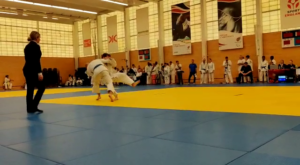
The vast majority of players on the circuit do a few things before going up for a fight. They’ve created some physical cues which get them into the right mental state, the optimal state of arousal to increase their chances of peak performance .
That physical cue is different for everyone: Some jump on the spot and then land with a thud. Others stomp two steps in their own quasi-ceremonial manner. A few do something more subtle.
They do something physical to trigger a mindset that they’ve fostered. This mindset has been honed for the specific purpose to re-frame their tournament nerves. It sets them up to perform to their fullest potential.
What is this competition mindset? It’s a one-track mindset of “I’m hear to perform. I’m shutting out the noise. I’m hear to do what I’ve been training for, to test myself. To show everything I can do, at the point where I’m at right now. Nothing more. Nothing less”.
If this is all news to you and you’ve never heard this before, try it:
- Think about yourself performing on the day, and succeeding in your chosen techniques. You don’t have to visualise yourself winning (and the emotion that brings), just see yourself getting your way in the exchanges. See the other person making mistakes. See your battle plans in action. Think how positive it feels to get your way, to impose your will, to jam their signals and movements. You are the ice man/woman, just doing what you need to do.
- Then think about a movement that you can do to associate a physical action with that mindset. Maybe shrug your shoulders with purpose, slap your forearm, jump on the spot, do anything (or set of things), but think of something you can do while you’re waiting to be invited onto the mat. Make the mindset you conjured up one and the same as your chosen physical action. Plain and simple. Don’t go overboard, don’t labour this too much.
On the topic of music

I used to think that loud heavy metal music was just the ticket, the tool I could use to get me ready to go. Listen to some energetic music and I’ll be ready to rock. Personally I have found that it actually makes it WORSE for me because I get so hyped up that I crash early in my rounds.
What’s recently worked for me is to listen to some calming music before reaching the venue. My current favourite is an electro band called Air, it worked wonders for me in my Dan grading. Highly recommended!
To conclude
- Accept that it’s normal to feel a little bit stressed about competing.
- Recognize that everyone else competing will be feeling exactly the same.
- Work out why you’re competing, learn from it.
- Visualise your optimal competition mindset.
- Practise triggering it with your chosen physical cues.
- Enjoy the day!
- If you want to read more on the topic, speak to your coach (obviously). If you’re like me and like to absorb what others have written up on the topic previously I highly recommend Stephan Kesting’s blog, he’s had some great articles over the years on competing generally: https://www.grapplearts.com/?s=competition+mindset
And what about you?
We’ve all had those “heart-in-mouth” moments before stepping onto the mat. Do you have a specific ritual or a song that gets you in the zone? Or perhaps a “competition horror story” that taught you a valuable lesson? Drop a comment below and share your experience—it might be exactly what someone else needs to hear before their next event.