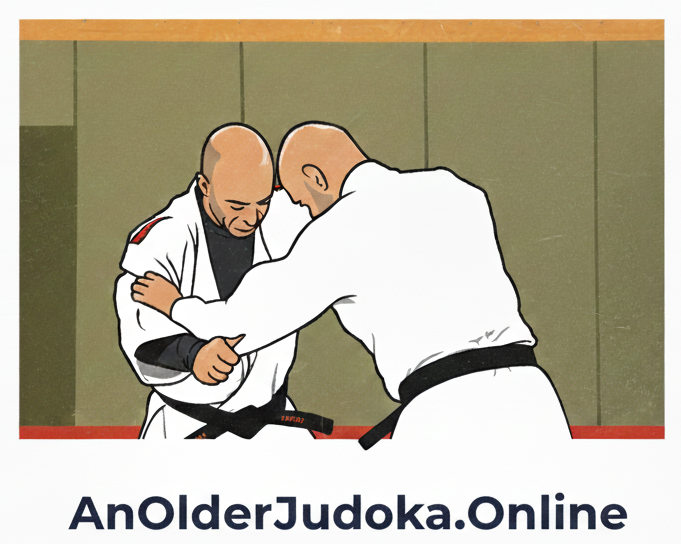
Our sport involves a lot of gripping and you quickly get to realise that there’s a lot more to it than just gripping cloth. One facet of it is to grip your opponent in such a way as to get a firm, advantageous hold so that you can throw your opponent. The other facet is to get a sense of what your opponent is doing, thinking, working towards. I liken it as Control and Communication.
This post is aimed to give you some insight from my own recreational study of the topic.
If you do Judo, your fingers will take a battering
No doubt about it, your fingers will suffer. They take a beating every session and we ask a lot from them. Each time you grip (and you have to do it relentlessly, throughout a session) you will be straining and exercising those muscles and making them move in unpredictable, challenging ways.
Treat them well, tape them up, look after your nails (particularly if you’re older and noticing some protein deficiency). They will morph over time to look like the hands of a climber (best case) or the hands of Quasimodo’s (worst case).
Fun anecdote! I had my finger pricked as part of a medical check and the nurse was struggling to draw blood from my finger tips. She asked me if I did climbing, I responded with pride: “No, I do JUDO” :-).
A finger breakdown
Let’s talk about the fingers individually:
- Thumb – all your other fingers have three bones each (called phalanges, if you want to get technical about it), your thumb though has only two. It may have fewer bones but it’s the strongest digit in your hand, it moves in more directions than the others and you use it the most.
- Index finger – the one you use to do the most delicate movements. If you were to lose a finger, surprisingly enough, this is the one that scientists suggest would have the least impact on your quality of life!
- Middle finger – mostly used alongside other fingers.
- Ring finger – It uses the same tendons as your middle finger.
- Little finger – small but mighty. Your little finger has almost half of your hand’s strength.
60% of your overall hand strength comes from your thumb, 40% comes from your pinky side. That said, you have a stronger connection with your pinky side, so you should prioritise that.
How to grip?
What you shouldn’t be doing is straining your whole arm as part of your grip. Instead, your grip should be like that of a mini flag waving: lots of wrist articulation, movement, but the finger gripping is appropriately strong.
It shouldn’t be a deathly grip except for when you have a plan and you’re going for a throw or feint. Use your Death Grip as sparingly as possible, realise that you only have so much you can use in a given time period, so be efficient with it.
When you’re grabbing material, you should aim to pull your wrist out and upwards, twisting it so that your little finger is up and out. You’re then pushing your thumb down or out. This is capitalising on the strength of your grip. I’ve not heard a coach online or in person deviate from this rule.
Where to grip
Common guidance suggests you should be gripping with an inside grip. By ‘inside’ I mean that you should have your hands on the inside of uke’s body. Ideally uke’s arms, if they’re gripping you, are on the outside. This is known as ‘winning position’; it puts you at an advantage.
Really though, it’s where you’re happy with your game plan and your throws. If you’re a top gripper, then you do you, but consider the above points regarding what gripping you make.
Lapel gripping vs Sleeve gripping
Your gripping location is pretty vital. In the heat of battle you get what you’re given, let’s be honest! But when you dominate the grip and get to pick and choose:
- Lapel gripping gives you the most optimal distance control. You push them out, they go out. You pull them in, provided you don’t have masses of slack, you get them closer to you.
- Sleeve gripping gives you most optimal directional control. You get to shift them out the most in the direction of your choice.
I simplify the above somewhat, since the location of that grip will change your situation dramatically. For example, if you’ve got the grip of their lower part of their lapel and it’s slack and flappy – that’s pretty impractical. Equally if you’ve got the end of their sleeve, there’s a lot that they can do with their arm which can jeopardise your plans and ruin your carefully curated game.
Conclusion
As you’ll have likely gathered, I haven’t provided a mystical, super secret, bulletproof game plan that will make you unstoppable on the world stage. What I have provided you with is hopefully a little more insight than the usual “grip here, pull there”. You’ll figure out what works for you. You’ll see the pros and cons of each, and how people respond to your gripping decisions.
Hopefully, you’ll also save your fingers and reduce the beating they take!